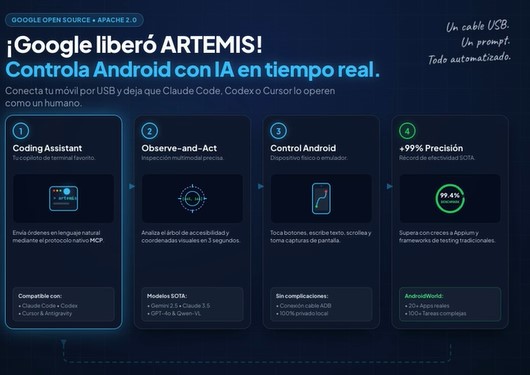
If you have ever spent hours maintaining test scripts that break the moment someone moves a button a few pixels to the left, ARTEMIS might be the most important open source release of the year for mobile developers. On September 18, 2026, Google officially published this project under the Apache 2.0 license, and its ambition matches its mythological name: let artificial intelligence take the wheel of your Android device so you don't have to.
What ARTEMIS Does and How It Works
At its core, ARTEMIS is a bridge between an Android device — physical or emulated — and the AI coding assistants developers already use daily: Claude Code, Codex, Antigravity, and Cursor. The connection runs through the Model Context Protocol (MCP), an emerging standard that is quickly becoming the go-to interface for linking AI agents with external tools and environments.
To understand and interact with the device, ARTEMIS relies on two complementary perception layers working in tandem:
- AI vision: multimodal models such as Gemini, Claude, or GPT-4o analyze the screen visually, interpreting layout and content much like a human tester would.
- Android accessibility tree: ARTEMIS reads the underlying UI structure directly from the operating system, giving it a precise, semantic understanding of every element on screen.
This dual approach is what sets ARTEMIS apart from earlier automation frameworks. When a visual redesign throws off pixel-based detection, the accessibility tree keeps the agent anchored. When the tree lacks context — think dynamic content or image-heavy screens — computer vision fills the gap. The result is a level of robustness that traditional tools like Espresso or UIAutomator simply cannot match out of the box.
All execution happens entirely on-device via ADB (Android Debug Bridge), with no data leaving the local environment. For organizations with strict privacy policies or compliance requirements, that is a genuinely meaningful architectural choice, not just a marketing bullet point.
The Numbers: Over 99% on AndroidWorld
Google is claiming a remarkable benchmark result: ARTEMIS achieves over 99% task completion on AndroidWorld, the most widely used evaluation suite for Android automation agents. Previous state-of-the-art systems fell well short of that threshold, which puts ARTEMIS in a league of its own — at least according to current published benchmarks.
AndroidWorld is not a toy benchmark. It covers a wide range of realistic tasks: navigating system settings, interacting with third-party apps, filling multi-step forms, and handling conditional flows. Scoring above 99% on that suite implies a degree of generalization that scripted automation has never reliably achieved. Whether those results hold up in the messy diversity of real-world production apps remains to be seen, but the number is hard to dismiss.
Who Should Pay Attention to ARTEMIS
The most immediate audience is mobile QA teams. With ARTEMIS connected to an AI coding assistant, a quality engineer can describe a test scenario in plain English — "open the app, log in with these credentials, navigate to the payment screen, and confirm the submit button is enabled" — and the agent will execute it without writing a single line of traditional test code. That alone could dramatically reduce the maintenance burden that kills most mobile test suites over time.
Beyond QA, the use cases fan out considerably:
- Mobile developers who want to automate repetitive tasks during development cycles, such as navigating to deep app states or populating test data.
- Accessibility auditors who need to verify that the accessibility tree is correctly implemented across an entire app without manual inspection.
- Power users who want to automate personal workflows on their Android device without relying on proprietary macro tools.
Because ARTEMIS ships under Apache 2.0, enterprises can adopt, fork, and integrate it into existing CI/CD pipelines with no licensing friction. That matters enormously for platform engineering teams evaluating long-term commitments to open source tooling.
MCP and the Bigger Picture
ARTEMIS adopting MCP is not an accidental choice. Originally championed by Anthropic and now embraced by a growing number of players across the AI tooling ecosystem, MCP is positioning itself as the standard protocol for connecting AI agents to external systems and environments. Google's decision to build an official project around it sends a strong signal: MCP is not a niche experiment, it is infrastructure.
Taken together, ARTEMIS represents a meaningful shift in how mobile software is built and tested. The model where a human manually writes and maintains fragile automation scripts is looking increasingly dated. In its place, AI agents that understand interfaces semantically and adapt to change are becoming first-class citizens in the development pipeline. If you work with Android in any professional capacity, now is a good time to clone the repository and start experimenting.