The Hidden Cost of Conventional MCP Tool Calls
When the Model Context Protocol emerged as a standard for connecting AI models to external tools, developers embraced the flexibility it promised. An AI agent could query databases, call APIs, read files, and trigger workflows — all from a single conversation interface. What was less celebrated was the architectural tax baked into the default interaction pattern: one tool call, one round-trip, one context update. Repeat until done.
In practice, this means that a relatively simple agentic task — say, fetching user data, checking inventory, and generating a report — could require three separate network round-trips, each one appending its result to an already-growing context window. By the time the model reaches the final step, it is carrying a bloated conversation history full of redundant and stale information. The token count climbs. Latency compounds. And in production environments serving thousands of users, those inefficiencies translate directly into operational costs.
Code Mode: One Script, One Trip, One Result
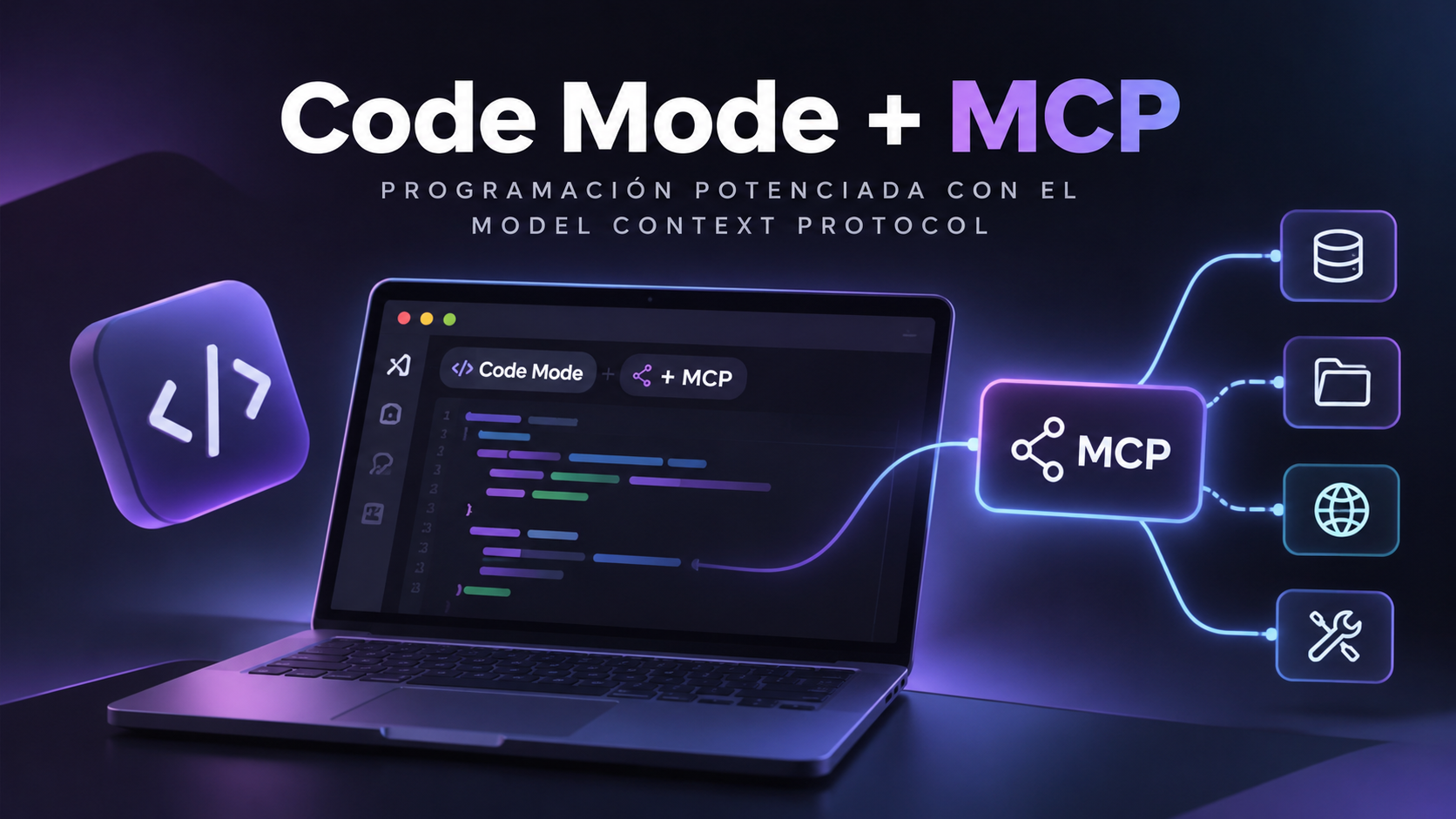
The Code Mode optimization addresses this problem at its root. Instead of invoking tools one at a time in an interactive back-and-forth loop, the AI model writes a complete script or code block that chains all the necessary tool calls together — sequentially or with conditional logic — and sends it to the MCP server for execution in a single dispatch. The server runs the script, collects all outputs, and returns a single consolidated response.
Cloudflare was among the first to popularize this pattern with its Code Mode implementation for MCP servers running on Workers, but the architecture is provider-agnostic. Any team building on the MCP specification can implement this pattern using a sandboxed execution environment on the server side. The model writes the plan once; the server executes it once; the result comes back clean.
The analogy that makes this intuitive: instead of asking an assistant to make three separate trips to retrieve a book, a pen, and a notebook, you hand them a written list and they return with everything in one go. The efficiency gain is obvious in human terms — and it is equally real in computational ones.
The Numbers: Over 60% Token Reduction in Long Conversations
Engineering teams that have deployed Code Mode in production report token savings exceeding 60% in extended conversations. The structural reason is straightforward: by eliminating intermediate round-trips, the context window never accumulates the repeated intermediate responses that inflate token counts in the conventional model. The model writes its intent once, the execution happens server-side, and only the final result is returned to the conversation.
Latency improvements are equally striking. A workflow that previously required five sequential tool calls — each with its own network round-trip overhead — collapses into a single execution cycle. On globally distributed infrastructure like edge networks, where each round-trip might cross continents, this compression produces response times that feel near-instantaneous to end users.
Implementing Code Mode: What Your MCP Server Needs
Getting Code Mode working in practice requires three things: a sandboxed execution environment on the server, tools exposed as callable functions within that environment, and a model instructed to prefer script generation over individual calls when multiple tools are needed.
- Set up a secure execution sandbox: The server must be able to run arbitrary model-generated code in an isolated environment with controlled access to registered tools only.
- Expose tools as callable functions: Each MCP tool should be available as a named function within the script execution context, with clear input/output contracts.
- Update the system prompt: Explicitly instruct the model to generate a script whenever it detects that more than one tool will be required to fulfill a request.
- Handle errors gracefully within the script: Generated code should include try/catch blocks or equivalent error handling so that a partial failure does not void the entire operation.
- Return structured consolidated output: The server should return a single JSON object containing the results of every tool call, labeled clearly for the model to parse efficiently.
Security Considerations and Trade-offs
Code Mode is not without risks. Executing model-generated code on a server introduces attack surface that must be managed carefully. The sandbox must be genuinely isolated — no unauthorized file system access, no unrestricted outbound network calls, no exposure of sensitive runtime data. Debugging AI-generated scripts can also be more complex than tracing individual tool calls, since errors surface in a different execution context than the conversational flow.
It is also worth evaluating fit. For short conversations involving one or two tools, the overhead of generating and executing a full script may offer no meaningful advantage over conventional calls. Code Mode delivers its strongest returns in complex agentic pipelines with long tool chains, and in production applications where token cost and response speed are hard business constraints.
What This Signals About the Future of AI Agents
The rise of Code Mode is a signal about where agentic AI design is heading: toward architectures that minimize friction between a model's reasoning and its ability to act. As language models become more reliably capable of generating correct, executable code on the first attempt, this pattern will increasingly displace the one-call-at-a-time model that characterized MCP's early adoption phase.
For teams already running MCP servers in production, Code Mode is not a roadmap item — it is an optimization available today, with measurable returns visible on the next token billing cycle. The question is not whether to adopt it, but how quickly the implementation can be scoped and shipped.